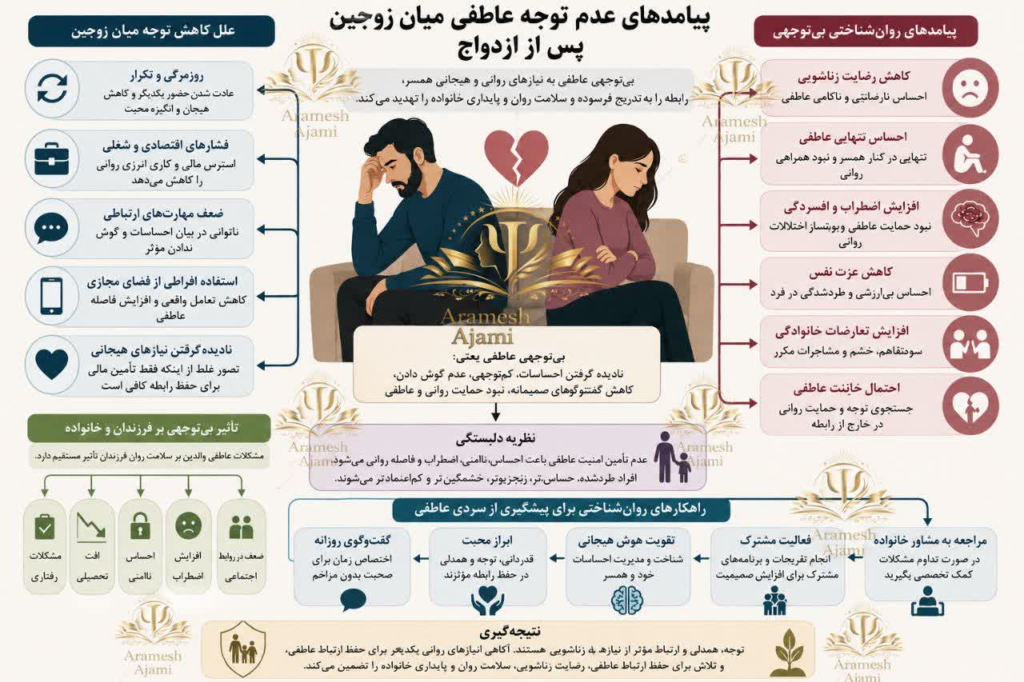
Marriage is more than a legal or social bond; it is an emotional and psychological relationship between two people that requires constant attention, care, and support. In the early years of marriage, the level of emotional attention and excitement is usually high; but as time passes and responsibilities increase, some couples gradually distance themselves from each other’s emotional needs. Psychologists believe that emotional neglect is one of the most damaging factors in marital relationships because, unlike obvious conflicts, it gradually and silently wears out the relationship. In many cases, couples live together on the surface, but they are psychologically and emotionally distant and lonely. The concept of emotional neglect in marital life Emotional neglect is a condition in which the psychological, emotional, and communication needs of the spouse are ignored. This neglect may occur directly or indirectly.
Common examples of inattention: Not listening to your spouse, ignoring the other person’s feelings, reducing intimate conversations, dismissing emotional problems as unimportant, lack of psychological support, spending too much time online or at work. According to John Gottman, constant inattention destroys the “emotional connection” between couples and paves the way for increased emotional distance. Causes of decreased attention between couples after marriage 1. Routine and repetition After a while, some couples get used to each other’s presence and expressions of affection decrease. 2. Economic and job pressures Financial problems and job stress can reduce people’s mental energy and diminish emotional attention. 3. Poor communication skills Lack of conversation skills and inability to express emotions increase emotional distance. 4. Excessive use of cyberspace, excessive dependence on mobile phones and social networks, reduces real interaction between couples. 5. Ignoring emotional needs Some people think that providing finances is enough to maintain a relationship; While emotional needs play a more important role in marital satisfaction. Psychological consequences of neglect of couples: Decreased marital satisfaction, lack of love and attention, creates feelings of dissatisfaction and emotional failure. Feelings of emotional loneliness: A person may live with their spouse but feel psychologically lonely. Increased anxiety and depression: Lack of emotional support can lead to mental disorders. Decreased self-esteem: Continuous neglect causes feelings of worthlessness and rejection in the individual. Increased family conflicts: Emotional distance increases misunderstanding, anger, and arguments. Possibility of emotional betrayal: In some cases, lack of attention and affection may lead a person to seek emotional support outside the relationship. Attachment theory and emotional neglect: Based on the Attachment Theory proposed by John Bowlby, humans have an inherent need for emotional security. When this need is not met in a marital relationship, feelings of insecurity, anxiety, and psychological distance increase. People who feel rejected in their relationships usually: have more emotional sensitivity, get angry or frustrated more quickly, and have less trust in the relationship. The impact of neglect on children and family Emotional problems between parents are not limited to the couple themselves, but also have a direct impact on the mental health of children. Possible effects on children: Increased anxiety Feelings of insecurity Academic failure Behavioral problems Weakness in social relationships A family in which emotional connection is weak usually creates an unstable psychological environment for children to develop. Psychological strategies to prevent emotional coldness 1. Daily conversation Allocating a specific time to talk without cell phones or distractions. 2. Expressing affection Simple behaviors such as gratitude, attention, and empathy are very effective in maintaining the relationship. 3. Strengthening emotional intelligence Recognizing your own and your partner’s feelings helps to better manage the relationship. 4. Creating joint activities Doing joint recreation and programs increases intimacy. 5. Referral to a family counselor if problems persist, specialized intervention can prevent the damage from worsening. Conclusion: Lack of emotional attention between couples is one of the most important factors in the erosion of marital relationships, which can affect the individual’s mental health, quality of life together, and even the psychological development of children. Family psychology emphasizes that attention, empathy, and effective communication are the basic needs of any emotional relationship. Couples who are aware of each other’s psychological needs and strive to maintain emotional connection will enjoy greater marital satisfaction and family stability. References (APA Style) John Gottman, J. M. (1999). The Seven Principles for Making Marriage Work. New York: Crown Publishers. John Bowlby, J. (1988). A Secure Base: Parent-Child Attachment and Healthy Human Development. New York: Basic Books. Sue Johnson, S. (2008). Hold Me Tight. New York: Little, Brown and Company. Carl Rogers, C. (1961). On Becoming a Person. Boston: Houghton Mifflin. Clinical Psychology
Common examples of inattention: Not listening to your spouse, ignoring the other person’s feelings, reducing intimate conversations, dismissing emotional problems as unimportant, lack of psychological support, spending too much time online or at work. According to John Gottman, constant inattention destroys the “emotional connection” between couples and paves the way for increased emotional distance. Causes of decreased attention between couples after marriage 1. Routine and repetition After a while, some couples get used to each other’s presence and expressions of affection decrease. 2. Economic and job pressures Financial problems and job stress can reduce people’s mental energy and diminish emotional attention. 3. Poor communication skills Lack of conversation skills and inability to express emotions increase emotional distance. 4. Excessive use of cyberspace, excessive dependence on mobile phones and social networks, reduces real interaction between couples. 5. Ignoring emotional needs Some people think that providing finances is enough to maintain a relationship; While emotional needs play a more important role in marital satisfaction. Psychological consequences of neglect of couples: Decreased marital satisfaction, lack of love and attention, creates feelings of dissatisfaction and emotional failure. Feelings of emotional loneliness: A person may live with their spouse but feel psychologically lonely. Increased anxiety and depression: Lack of emotional support can lead to mental disorders. Decreased self-esteem: Continuous neglect causes feelings of worthlessness and rejection in the individual. Increased family conflicts: Emotional distance increases misunderstanding, anger, and arguments. Possibility of emotional betrayal: In some cases, lack of attention and affection may lead a person to seek emotional support outside the relationship. Attachment theory and emotional neglect: Based on the Attachment Theory proposed by John Bowlby, humans have an inherent need for emotional security. When this need is not met in a marital relationship, feelings of insecurity, anxiety, and psychological distance increase. People who feel rejected in their relationships usually: have more emotional sensitivity, get angry or frustrated more quickly, and have less trust in the relationship. The impact of neglect on children and family Emotional problems between parents are not limited to the couple themselves, but also have a direct impact on the mental health of children. Possible effects on children: Increased anxiety Feelings of insecurity Academic failure Behavioral problems Weakness in social relationships A family in which emotional connection is weak usually creates an unstable psychological environment for children to develop. Psychological strategies to prevent emotional coldness 1. Daily conversation Allocating a specific time to talk without cell phones or distractions. 2. Expressing affection Simple behaviors such as gratitude, attention, and empathy are very effective in maintaining the relationship. 3. Strengthening emotional intelligence Recognizing your own and your partner’s feelings helps to better manage the relationship. 4. Creating joint activities Doing joint recreation and programs increases intimacy. 5. Referral to a family counselor if problems persist, specialized intervention can prevent the damage from worsening. Conclusion: Lack of emotional attention between couples is one of the most important factors in the erosion of marital relationships, which can affect the individual’s mental health, quality of life together, and even the psychological development of children. Family psychology emphasizes that attention, empathy, and effective communication are the basic needs of any emotional relationship. Couples who are aware of each other’s psychological needs and strive to maintain emotional connection will enjoy greater marital satisfaction and family stability. References (APA Style) John Gottman, J. M. (1999). The Seven Principles for Making Marriage Work. New York: Crown Publishers. John Bowlby, J. (1988). A Secure Base: Parent-Child Attachment and Healthy Human Development. New York: Basic Books. Sue Johnson, S. (2008). Hold Me Tight. New York: Little, Brown and Company. Carl Rogers, C. (1961). On Becoming a Person. Boston: Houghton Mifflin. Clinical Psychology